


Round 11 is up and that means a visit to Detroit, Michigan! This round is misleading as the location and seasonality would lead most to think that Detroit will be soft and rutty. Strange as it may be, it rarely is rutty. Instead, most years it becomes slippery and hard by the main events. Even when it’s been below freezing outside Ford Field, the track inside the dome remains drier than expected. Let’s peek at what 2026 has in store.
The start for Detroit is fairly short and into a right hander. The shorter start will add emphasis to afternoon qualifying position and heat race finish. The long right-hand corner will make it difficult for those on the outside to succeed unless they can get a superb jump from the gate and cut across to the apex aggressively. All things being equal, though, this start setup favors the gates on the inside of the box.
The first rhythm section features the “carrot jumps” that are often utilized at Daytona. After doubling through, riders will make a 180 right and into a short rhythm section. This rhythm has three basic options: Riders can triple from the turn and then go tabletop-over-single, double from the corner and then jump on-off to the outside berm or double from the corner, jump over the tabletop and single to the inside line. If the dirt is hard packed, the third option inside line here will be less usable because of the lack of traction exiting the next corner.
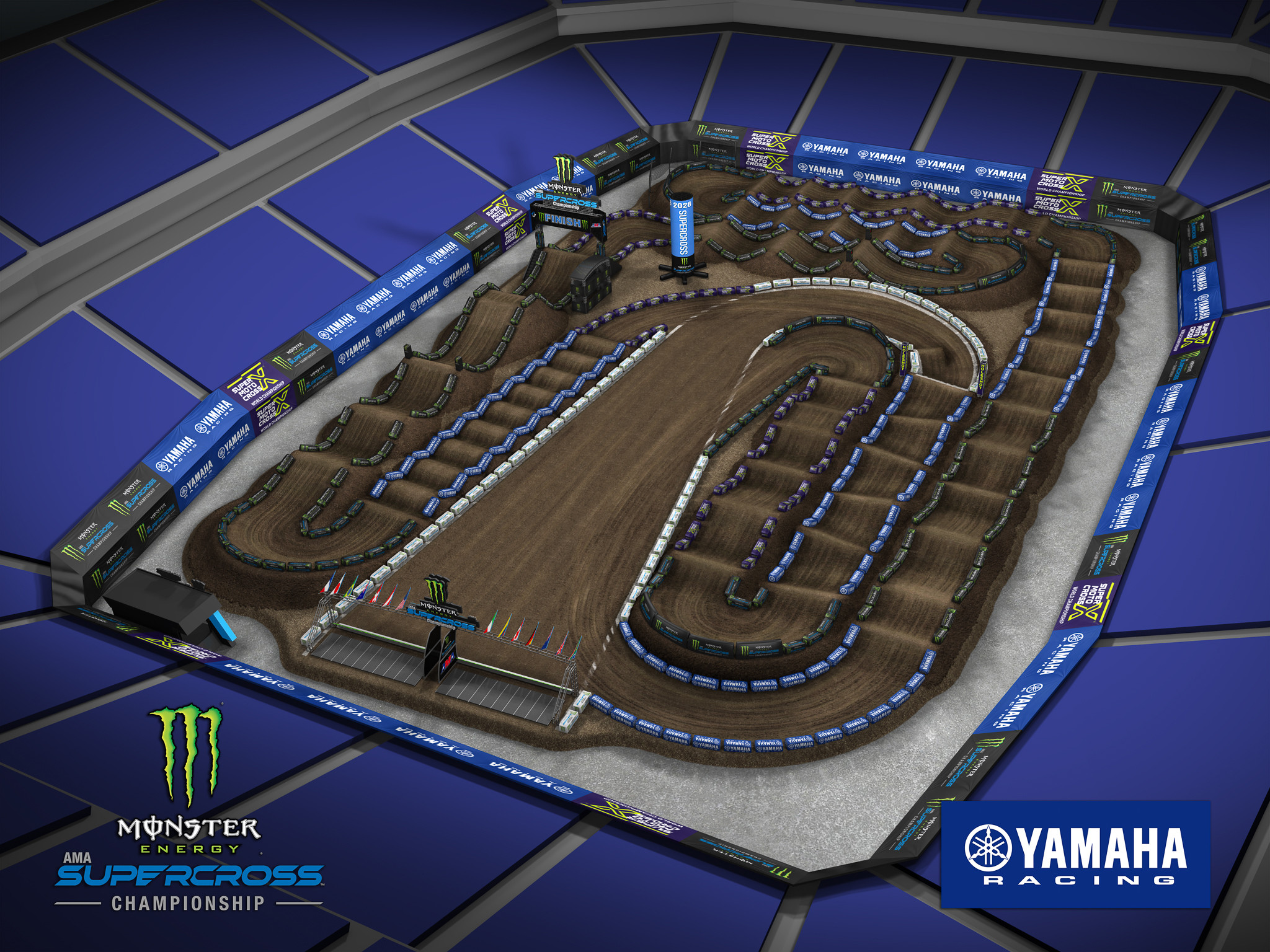
Riders bend back down the start straight and into a sweeping 180 to the left. This positions riders for a stadium length rhythm section. There are a few ways to execute this section, but I like 2-3-3-3 or possibly 2-3-3-2-1 to the inside. The triples in the middle land on the backsides of taller jumps which is ideal. There is a chance that 3-3-3-2 becomes usable but I don’t like the setup from the corner. Riders would have to swing very wide and then drive across the main line to do this, opening a great opportunity for a following rider to ride right into blocking position. It just feels a bit forced so watch for riders to stick inside and double in.
The next 90 left sends riders along the width of Ford Field, and this has one primary line with a possible but tougher second. The most used line will be to step over the tabletop type jump and then go 2-2 into the next 180. The other option is to step up onto the tabletop type obstacle, step off and then triple. The tough part is getting off that tabletop if the gap is far. This type of setup was recently used in Anaheim and both lines were used so maybe it’s more usable that I am giving credit for. Time will tell.
The next rhythm has five similarly built jumps and this will either be a 2-3, 3-2 or 2-2-1. This is an identical build to what we saw in Birmingham right after the whoops. With a bowl berm after, though, I think the 2-2-1 will be far less utilized than a week ago. There is no upside to hopping to the inside after the corner with a standard supercross triple lying in wait. 3-2 for the 450’s and 2-3 for the 250’s is the most likely outcome here.
After said triple, riders land into an immediate 90 to the right and into the finish line. Riders will want to land on the middle/right of the triple landing and cut across the inside of the 90 towards the finish line. The only reason they would land further left is if a rider is right on their tail and they need to protect that inside line before the finish. There is zero reason to use the berm in the 90 before the finish so it will likely not be used much.
Upon landing the finish, there is another standard supercross triple and we don’t see this combo often. Landing the triple, most riders will drive deep into the next 180 and come out firing into the next set of whoops. If the dirt is soft, some may dive inside before the whoops and then jump through. This line could also come in late in the mains if the berm deteriorates and the whoops become jumpers. On a well-groomed track, the outside berm is the way to go, though.
The final stretch swings across the first corner and back towards the carrots.
- Supercross
- Race Day Live (Qualifying)LiveMarch 28 - 1:00 PM

- Race Day Live (Qualifying)LiveMarch 28 - 1:00 PM

- Main Program Night ShowLiveMarch 28 - 7:00 PM
- Main Program Night ShowLiveMarch 28 - 7:00 PM

- Main Program Night ShowLiveMarch 28 - 7:00 PM

Who’s Hot
Cole Davies has won two races in a row (yes, I know this is misleading) and continues with the red plate.
Hunter Lawrence has won three out of the last four races and holds a nine point lead over Eli Tomac. What a career arc for the 96.
Ken Roczen was on rails in Birmingham and is determined to stamp out the “second half slide” rhetoric.
Malcolm Stewart turned in his best ride of the season and might finally be healthy enough to be a podium factor.

Who’s Not
Pierce Brown went down hard in the main and will be out for a while with a broken collarbone and dislocated wrist. Huge bummer for PB.
Aaron Plessinger cannot, under any circumstances, buy a break.
Bold Predictions
After past Detroit finishes of 17 and 21 for Seth Hammaker, he is seen waving sage around, searching for heads-up pennies, has a four-leaf clover butt patch, and uses an innovative crossed fingers technique on the clutch.
Haiden Deegan doesn’t attend Detroit but continues the win streak to seven in a row.