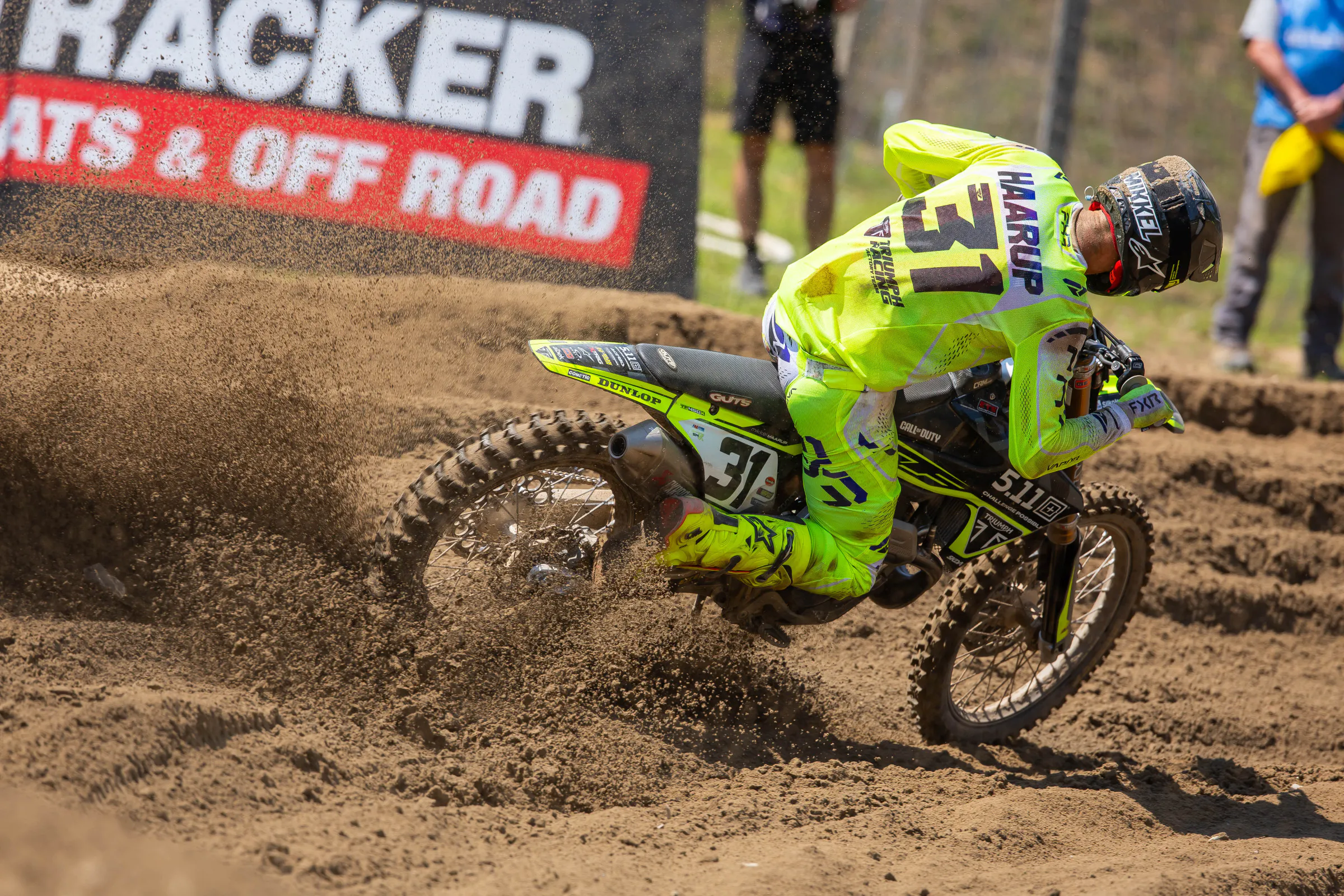

Mikkel Haarup has been with Triumph’s motocross program from the start, first in the MX2 class in MXGP, and then through the 250 and now 450 class here in the U.S. Since he aged out of the MX2 class and Triumph didn't have a 450 ready, he moved to the U.S. last year. He’s been solid, for sure, taking sixth in points last year in the 250s, and had been top ten in all but one race this year in the 450 class until a rough go in Millville. At that race, Sophie Phelps caught up with the Danish rider to learn more about his journey from MXGP, to America for the last two years, and then back to Europe next year.
After this interview on Saturday morning at Millville, Haarup had a tough day when he collided with Garrett Marchbanks in moto one, which resulted in a broken nose. Then he had bike trouble in moto two. He sits ninth in points heading to Washougal. Let's get to know the friendly rider making his way on both continents.
Racer X: Okay. Is English your first language?
Mikkel Haarup: No! In Denmark we speak Danish, but Danes are in general known for being quite good at speaking English, so we excel at it, I would say. Yeah, we speak English from when we are six or seven years old at this point, or we start learning it. And I've been traveling since I was young, so for me it's easy.
That’s interesting because there's like a good portion of things that you say where I wouldn't even guess that English wasn't your first language! Do you speak more than two languages?
I studied German and I will pick up on it, I'm not able to speak it so it doesn't count in my opinion. Same with Dutch. At the moment because I've bought a house down in Spain, so I'm trying to learn Spanish and it's going pretty well. I want to go there and hear the people talk and because it's just way different when you're not speaking it on a day to day basis, you just don't pick up on it in the same way.

Okay so you bought a house in Spain. Is that for next year?
That is for next year, yeah.
Can you talk a little bit about that because I heard you weren't supposed to be over here as long as you have been over here, right?
Yeah. So, Triumph had an injury, I believe at the time it was either Jalek [Swoll] or Stilez [Roberston] last year, and they called me up. I said I would love to come over, experience it. I was on a contract with Triumph already, but as a test and development for the 450 program in Europe and I came over here, I believe in January or February, and then raced outdoors last season. Then halfway through the season, I think it was around RedBud time last year, they called me and said, ‘Hey, we're postponing the 450 program for another season in Europe. Would you want to stay and do the 450 in America instead?” Because over here we don't have the regulations with the frame and stuff. I said, “Yeah, why not? Hell yeah.” So, because of that, we extended my contract and my contract is to go back next year.
Okay, and you seem a little bit excited about that. Is that fair to say?
I'm always excited for a challenge, but, I mean, I would be excited for racing another season over here as well! I feel like we have a lot left to prove, and because it's the first season, there's so much to improve on. I've been over here for two years. Obviously, I've been in Europe for most of my career, and there are certain things that you do miss. There's no doubt about it. There's some people that I miss, I miss more actually off the track, just living close to your family. I know Spain, it's still a three-hour flight, but it's still easier than going to America, which is super expensive and at least a nine-hour flight. So, it’s more just the family and friends thing off the track, because racing over here in America and racing in Europe, although the programs are different, at the end of the day it's still racing.
Yeah, I love that. So, you're cool as far as the racing goes here or there. Are there things like pros and cons that you notice as far as racing here, like, “Oh, I love this so much better”, or aspects you don’t like as much?
I've come to like the one-day format a lot because the two-day format leaves you with not much time in between the weekends. So, imagine we were here two days. You only get one day on the bike most likely during the week, you're barely home. I found this one-day format good. I think if you're new to the series or new in general, I think the two-day format is nice just because you have more track time, but so that's like a give and take. The amateur program in Europe is better, because already from the 85s, you get to race on some of the pro tracks, and you get a lot more track time. Over here, because I've done some of the amateur races, you have five to 10 minutes, maybe 15 minutes at most, at some of these amateur events. Apart from the Loretta's final and the Mini O’s final. It's a big change going from 85, jumping straight up to a 250 because over here you guys don't do much 125 racing either. So, we we've got a class specifically for that that and it races at all the MXGP tracks. You get to experience what it's like. So that part I feel like Europe's nailed really well. But then there's the payout. I mean, over here, people get paid [purse money] from the organizers. In Europe, they don't do that [no purse money in MXGP] and that's a shame, I think, not so much for the guys like me and other factory boys, but more the outside of the top 20. I think getting a little bit of a paycheck, even though it's not a lot, and probably doesn't cover the costs, it's still nice, it still gives like a little bit of blood on the teeth knowing I can earn a little bit of money on this, not just pay out every weekend.
I appreciate your perspective. Can you talk about your developing the bike? I'm sure that's probably a pretty heavy job for you. So are you able to focus fully on racing. What would you say about that?
At this point I've taken a rider role, to be honest with you, so the energy spend is more or less the same at this point. There was a short period of time, from then end of ‘24, beginning of 25, where I did have some testing roles and I had to compromise a little bit in order to make things happen, but nowadays it’s a full on riding program. It's still tough. I think you can ask the Ducati boys as well, it's still tough developing a new bike. You don't have much data and much feedback to go off of. But other than that, I don't think it's too bad. I'm enjoying my time a lot with Triumph, and at this point I've been a little bit of a guinea pig right from the get-go, being the first guy with Triumph on the 250 in Europe and now on the 450 as well here. But I've enjoyed every bit of it.

That's pretty awesome. Now, as far as developing the bike in the 450s for the 450 program in Europe, do you feel like the bike is where you want it? I mean, obviously, there could be improvements on every bike, but what are your thoughts there?
We've got quite some good steps done already. I have not tried the Euro chassis for the 450 just yet, but the feedback here is quite good. That is something that obviously will be implemented over here with time, but because of the regulations, we can't do it right from the get-go. So, we're gonna see progress in the next 2-3 years for sure with the bike, that's gonna probably even give us an advantage on tracks, certain tracks. I'm excited for that, but obviously it's a patience game and takes a little time. It doesn't come from one day to another.
Can you speak to maybe your goals moving forward this season?
If I have to put a number on it, I'd say the goal is to be top five. Not top five in the championship because I think that's kind of gone and Marchbank's been very, very consistent around the top five, but just being able to get into a top five at least one of the rounds would be nice. It's not gonna be easy because everybody's trying to improve, and I know Marchbank's probably trying to get into the top three if I know him well enough, but I think that that's something we can be proud of. Let's see where we end up.